

















Using germicidal lamps

Properties of germicidal lamps. Types and choosing an antimicrobial lamp for the size of the room.
One of the most effective methods of disinfecting air is using germicidal tubes. The ultraviolet radiation they emit, with a wavelength of 250-270 nm, very effectively destroys all kinds of bacteria, viruses, moulds and fungi, causes no chemical contamination and removes the need for other chemical agents.
In flow-through germicidal lamps, air is disinfected inside a closed chamber, so these lamps are completely safe for people, animals and plants in the room. Contaminated air drawn into the disinfection chamber by a fan first passes through a filter that captures dust. This is important for reducing allergy risks for people in the room. Flow-through lamps should be used wherever rooms must be kept highly sterile while staff are present.
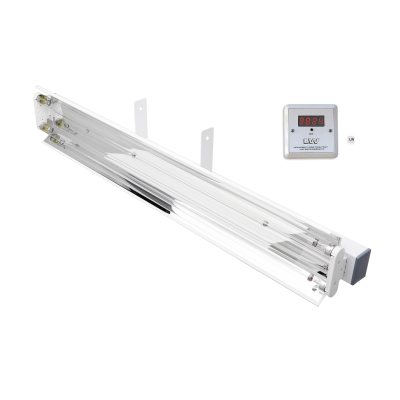
Direct-action germicidal lamps (where the tube emitting germicidal radiation is visible) should be used when nobody is in the room being disinfected.
The power of a germicidal lamp is chosen according to the size of the room to be disinfected. In practice we can assume that sufficient microbiological cleanliness is achieved (in a room 2.5-3 m high, at "room" temperature and humidity) with:
- up to 6 m²: a 15 W germicidal lamp.
- up to 10 m²: a 2 x 15 W germicidal lamp.
- 12-15 m²: a 30 W germicidal lamp.
- 18-20 m²: a 2 x 30 W germicidal lamp.
Germicidal lamps emit UVC radiation, which neutralises microbiological contamination within its range. With the right exposure time and UV intensity, microorganisms can be killed by destroying their DNA. To destroy specific microorganisms, UV doses are given in mJ/cm², the so-called germicidal doses.
Of the whole UV range of 100-400 nm, the range from 200 to 280 nm is responsible for the germicidal effect of ultraviolet light on microorganisms.
The literature states that the strongest germicidal effect occurs at wavelengths of about 250-270 nm. UVC effectiveness decreases, among other things, when a biofilm is present.
UVC lamps may also produce some ozone, which also disinfects, but unfortunately its presence in a room is undesirable for human health.
In flow-through lamps, air is disinfected in a closed housing, a chamber that prevents radiation from escaping, so people in a room with such a lamp are not exposed to its radiation while it is working.
In direct-action lamps, radiation is emitted onto the irradiated surface and at the same time spreads to the whole room. For this reason, using direct-action lamps requires safety measures that reduce the risk of people accidentally entering and staying in the room while the lamps are on. There should be clear signs at the entrance indicating that the lamps are on.
Switching on and using UVC lamps can significantly reduce microbiological contamination. Of course, an efficient air conditioning and ventilation system (supplying outside air to the room) is extremely important for clean air. The role of flow-through lamps therefore grows as the efficiency of the air conditioning and ventilation system decreases.
Microorganisms can pass from surfaces and equipment into the air of the room, which is undesirable, so direct-action lamps have a lot to do here. Remember, however, that UVC radiation must not be used while people are in the room.
Photo gallery


Leave a comment