





Ishihara Plates

Ishihara Plates

Ishihara plates for colour vision testing. Brands: GIMA. Prices and availability at SKLEP DLA LEKARZA. Read more about this category

Active filters

NATURFARM Ishihara Plates

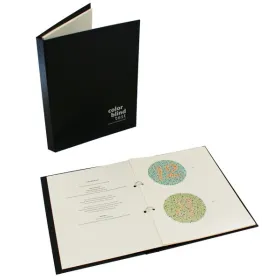
Ishihara-Type Plates - 24 Plates (Ishihara-Type Test, Pseudoisochromatic Plates)

Code: NFISHIHARY24 KOMPLET

Colour vision tests (for detecting colour blindness, Ishihara tests). Set of 24 plates with interpretation, used mainly in occupational medicine. Shows numbers and trails.

Colour vision tests (for detecting colour blindness, Ishihara tests). Set of 24 plates with interpretation, used mainly in occupational medicine. Shows numbers and trails.

Price PLN 333.71
Tax included

NATURFARM Ishihara Plates

Ishihara-Type Plates - 38 Plates (Ishihara-Type Test, Pseudoisochromatic Plates)

Code: NFISHIHARY38 KOMPLET

Ishihara colour vision tests allow quick and accurate assessment of the most common forms of congenital colour vision deficiency for certain colours (green and red). Set of 38 plates (full), mainly…

Ishihara colour vision tests allow quick and accurate assessment of the most common forms of congenital colour vision deficiency for certain colours (green and red). Set of 38 plates (full), mainly for determining the type of colour vision defect. Shows numbers and winding lines.

Price PLN 371.00 Regular price PLN 590.00
Tax included
  • -PLN 219.00
  • - PLN 219.00

About the category: Ishihara Plates

Tests of colour vision (Ishihara for adults and children, Velhagen, Matsubara). The dots in a colour different from the background form numbers or figures.

The colours differ on each plate, which makes it possible to diagnose various colour vision disorders. Some sets of Ishihara plates have an extensive explanatory part with explanations and figures of the correctly solved tests.
Ishihara plates (Ishihara pseudoisochromatic plates) are used by ophthalmologists to check the ability to tell red from green. They are named after their creator, the Japanese ophthalmologist Shinobu Ishihara, professor at the University of Tokyo, who designed the first plates in 1917. While Ishihara worked at the Military Medical School, he was asked to devise a simple test of whether recruits could recognise colours correctly. His work was certainly made easier by the fact that his assistant had exactly this condition. The first plates were painted by Ishihara himself.
The full Ishihara test consists of showing the patient 36 or 38 plates; screening versions have 14 or 24 plates, and the version for children and people who cannot read has 10 plates. The diagnosis is usually clear after a few plates.
Each plate is a circle of round dots of various sizes, in slightly different colours. The dots in a colour different from the background form a number, which the patient is asked to read. The colours differ on each plate, which makes it possible to diagnose various colour vision disorders.