
















Examination lights vs procedure lights: functional differences

When comparing lights by their purpose, different features matter...
When comparing lights by their purpose, different features and characteristics matter for examination lights and for procedure lights.
In the photo, from the left:
- FLH-3 LED shadowless examination and procedure light on a five-castor stand, with a gooseneck
- KLLED-KM17.20 mobile LED shadowless surgical and procedure light
- IGLUX mobile LED shadowless procedure and surgical light
- FLHD3 R LED shadowless examination and procedure light on a five-castor stand, with a gooseneck
In our test we considered intensity, light spot size and colour rendering (especially red). Intensity was measured with a certified lux meter with a calibration certificate, with the light source 1 metre from the measured spot.
It is clear that the Iglux 65M procedure and surgical light and the FLHD3 light (even though it is an examination and procedure light) have a much larger light spot, which allows simple surgical procedures, and they also work well as the main light in many procedure and operating rooms. In this post they serve as background to show the classification of medical lights (examination lights, procedure lights, surgical lights).
Here we would like to compare two examination lights (ORDISI FLH-3 and BakMed KM17.20).
Both lights have a light intensity of about 35,000 lux.
I don't understand why the manufacturer classified the BakMed KM17.20 as a procedure and surgical light when its light intensity is typical of examination lights!
Both lights have a light spot of similar size, but the colour temperature differs greatly.
The ORDISI FLH-3 gives a neutral light colour, an even spot and correct rendering of tissue colour.
The BakMed KM17.20 light is too warm, even a dirty yellow. Its colour rendering may make diagnosis difficult. The brown rim of the light spot speaks for itself.
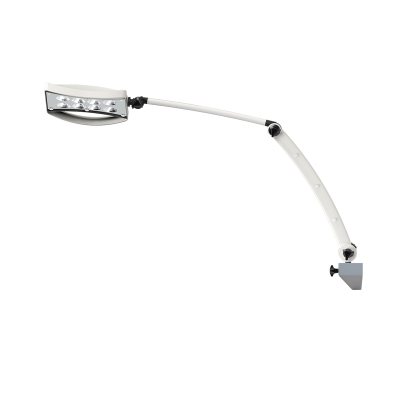
The BakMed KM17.20 is also much bulkier, which makes it awkward for diagnostic use.
In everyday work the user positions the light head close to themselves, so an examination light should be compact and not get in the physician's way. The short distance requires a dimming function. Unfortunately, the KM17.20 does not have it.
Another faux pas of the KM17.20 procedure light is the thickness, or rather thinness, of its power cable. Running over such a thin cable, for example with a chair on castors, can cause a short circuit and a failure: the light stops working.
A white cable lying on the floor, however clean the room, sooner or later stops being white.
Photo gallery


ORDISI ORDISI: Featured brand Examination Lamps
FLHD3 R Shadowless LED Examination and Treatment Lamp with Five-Castor Stand and Gooseneck
Code: FLHD3 R LED
The FLHD3-R shadowless LED examination and treatment lamp is designed to light the treatment field wherever professional, high-performance light is needed: in treatment rooms, dressing rooms and…
The FLHD3-R shadowless LED examination and treatment lamp is designed to light the treatment field wherever professional, high-performance light is needed: in treatment rooms, dressing rooms and operating theatres. The flexible, stable "gooseneck" arm allows the examined area to be lit precisely....

ORDISI ORDISI: Featured brand Examination Lamps
IGLUX Mobile Shadowless LED Treatment and Surgical Lamp
Code: IG-65M
The IGlux shadowless treatment and surgical lamp with a light intensity of 65 000 lx at a distance of 1 m, with light intensity adjustment.
The IGlux shadowless treatment and surgical lamp with a light intensity of 65 000 lx at a distance of 1 m, with light intensity adjustment.

KLLED-KM17.20 Mobile Shadowless LED Treatment and Surgical Lamp
Code: KM17.20
The KLLED-KM17.20 is designed to light the treatment field wherever professional, high-performance light is needed, i.e. in treatment rooms, dressing rooms and operating theatres, as an additional…
The KLLED-KM17.20 is designed to light the treatment field wherever professional, high-performance light is needed, i.e. in treatment rooms, dressing rooms and operating theatres, as an additional light source.

ORDISI ORDISI: Featured brand Examination Lamps
ORDISI FLH-3 Shadowless LED Examination and Treatment Lamp with Five-Castor Stand and Gooseneck
Code: FLH311
The FLH-3 LED (FLH311) examination and treatment lamp with adjustable intensity is designed to illuminate the treatment field wherever professional, high-performance light is needed, i.e. in…
The FLH-3 LED (FLH311) examination and treatment lamp with adjustable intensity is designed to illuminate the treatment field wherever professional, high-performance light is needed, i.e. in treatment rooms, dressing rooms, veterinary surgeries and elsewhere.
Leave a comment