























AWGS 2025 – simpler muscle assessment for sarcopenia

AWGS is a working group on sarcopenia formed by experts who set the rules for diagnosing sarcopenia, the age-related loss of muscle mass and strength. The group's guidelines are used all over the world. Their update, AWGS 2025, was published in 2025 in Nature Aging, a monthly scientific journal of Nature Portfolio devoted to research on ageing and age-related diseases. It brings three key changes:
- simpler diagnosis – two criteria are enough: low muscle mass and low muscle strength;
- earlier vigilance – for the first time there are cut-off values for people aged 50–64;
- a new goal – looking after muscle health throughout life, not only detecting the disease in older people.
The AWGS 2025 consensus bases the diagnosis of sarcopenia on muscle mass and strength and lowers the age of vigilance to 50. We show how to measure ASMI, ASM/BMI and handgrip strength with Charder devices.
As societies age, early detection of sarcopenia and timely intervention matter more than ever. The update simplifies the diagnosis, makes it easier to use in practice and puts the emphasis on early detection.
Until now the focus was mainly on diagnosing sarcopenia in older people. The goal now is to look after muscle health throughout life, starting in middle age, and a comprehensive assessment of both muscle mass and muscle strength is gaining importance. Below we summarise the key points of AWGS 2025 and show how Charder body composition analysers and hand dynamometers help professionals carry out the diagnosis in line with the new standards.
1. Simpler and earlier diagnosis of sarcopenia
Sarcopenia is the age-related loss of muscle mass and function. It carries serious health risks such as falls, functional disability and chronic disease. The AWGS update brings two key changes to how it is diagnosed.
Two-step diagnosis
Sarcopenia can now be diagnosed by showing:
- low muscle mass (muscle quantity) and
- low muscle strength (muscle quality).
Compared with the 2019 version, physical performance measures such as gait speed and the chair stand test are no longer part of the criteria. They are now seen as a consequence of poor muscle health rather than the starting point of the diagnosis – once physical performance declines, it may be too late for effective intervention. The new approach aims to catch low muscle mass and strength before they turn into serious mobility problems.
2. Vigilance from the age of 50
For the first time AWGS has set specific cut-off values for middle-aged people (50–64 years). Doctors can thus recognise the problem and act in patients in their fifties and early sixties, gaining valuable time to prevent the loss of muscle mass and strength. Muscle is treated not only as the tissue responsible for movement but as an important organ that plays a key role in healthy ageing: it supports metabolism, strengthens bones and, by acting on other organs, even supports cognitive function.
3. Key tools for muscle health prevention
Since the new diagnosis is based on muscle mass and strength, objective measurement with certified devices is more important than ever.
Measurements of muscle strength, muscle mass and physical performance in the AWGS 2025 consensus
| Measurement | Cut-off values | ||||
| Normalisation | Age 50–64 (M / F) | Age ≧ 65 (M / F) | |||
| Muscle strength | |||||
| Handgrip strength (kg) | <34.0 kg | <20.0 kg | <28.0 kg | <18.0 kg | |
| Muscle mass | |||||
| DXA | ASM/height2 (ASMI) | <7.2 | <5.5 | <7.0 | <5.4 |
| BIA | ASM/height2 (ASMI) | <7.6 | <5.7 | <7.0 | <5.7 |
| DXA | ASM/BMI | <0.80 | <0.55 | <0.73 | <0.52 |
| BIA | ASM/BMI | <0.90 | <0.63 | <0.83 | <0.57 |
| Physical performance (outcome) | |||||
| Five-time chair stand test (seconds) | ≧10.0 | ≧10.0 | ≧12.0 | ≧12.0 | |
| Gait speed, 6-metre walk (m/s) | <1.2 | <1.2 | <1.0 | <1.0 | |
Source: Chen, L., Hsiao, F., Akishita, M., Assantachai, P., Lee, W., Lim, W. S., Muangpaisan, W., Kim, M., Merchant, R. A., Peng, L., Tan, M. P., Won, C. W., Yamada, M., Woo, J., & Arai, H. (2025). A focus shift from sarcopenia to muscle health in the Asian Working Group for Sarcopenia 2025 Consensus Update. Nature Aging.
If the results are below these cut-offs, or the patient has a condition such as diabetes or chronic kidney disease, they should be considered at risk and a sarcopenia-focused intervention should start without delay.
The good news is that muscle health can be improved to a large extent. The consensus stresses that multi-component interventions work best: strength (resistance) training combined with adequate protein intake and nutritional supplements (e.g. essential amino acids), which give muscles the fuel to maintain and grow.
4. How Charder devices support sarcopenia assessment
Bioelectrical impedance analysis (BIA) is a recognised method of measuring skeletal muscle mass, needed to determine the Appendicular Skeletal Muscle (ASM) used in the diagnosis. Compared with DXA, BIA is faster and safer, which makes Charder body composition analysers a practical choice for clinics, health programmes and general fitness assessment.
1) Measuring skeletal muscle mass
AWGS 2025 provides two indicators for assessing skeletal muscle mass.
Appendicular Skeletal Muscle Index (ASMI)
ASMI relates muscle mass to height and gives a standardised measure of sarcopenia risk. The result is shown directly on the result sheet:

(example: medical result sheet of the MA801 analyser)
Appendicular Skeletal Muscle / Body Mass Index (ASM/BMI)
ASM/BMI relates muscle mass to BMI and, like ASMI, is used to assess sarcopenia risk, with the difference that it also takes the patient's body weight into account besides height. Both ASM and BMI are on the result sheet.
2) Estimating handgrip strength
Charder professional body composition analysers, such as the MA601, are the only ones to offer handgrip strength estimation. This is especially useful where handgrip strength is not measured routinely – if the estimated strength keeps falling, it is an important signal to carry out a functional test with a dynamometer.

3) Measuring handgrip strength
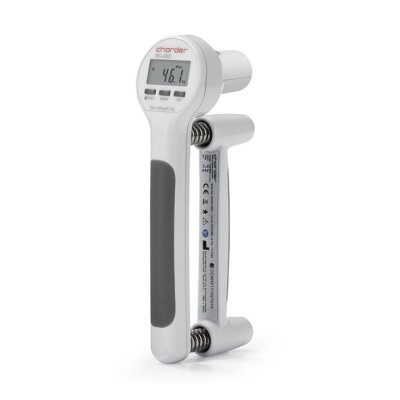
Handgrip strength is measured directly with a dynamometer. Most dynamometers on the market have a fixed, rigid handle for simplicity (e.g. the diagnostic version of the Charder MG4800). Versions with a spring-loaded, flexible handle (e.g. the rehabilitation version of the Charder MG4800) give a movement closer to a natural grip. Both types are a very good choice.

Summary
The AWGS 2025 update sends a clear message: muscle health needs to be measured now. By monitoring muscle mass and estimated strength with a Charder body composition analyser and confirming actual strength with a Charder hand dynamometer, patients and professionals gain key data to prevent decline and build the foundations of a healthy, active life.


Charder Charder: Featured brand Dynamometers
MG4800 Dynamometer (Force Gauge)
Code: MG4800
Charder MG4800 dynamometer (force gauge) with a variable load range. International design award. Measures grip strength.
Charder MG4800 dynamometer (force gauge) with a variable load range. International design award. Measures grip strength.


Charder Charder: Featured brand Medical Body Composition Analysers
Charder MA601 Medical Body Composition Analyser
Code: MA601
Professional clinical-grade medical body composition analyser Charder MA601 providing measurement values and data from a multi-frequency examination. Software and connection to a computer free of…
Professional clinical-grade medical body composition analyser Charder MA601 providing measurement values and data from a multi-frequency examination. Software and connection to a computer free of charge.


Charder Charder: Featured brand Medical Body Composition Analysers
Charder MA801 Medical Body Composition Analyser
Code: MA801
HIGH END analyser. Uses BIVA technology for patients with disturbed water balance. Applications: paediatrics - patients from 6 years, obesity, nephrology, geriatrics, sports medicine, aesthetic…
HIGH END analyser. Uses BIVA technology for patients with disturbed water balance. Applications: paediatrics - patients from 6 years, obesity, nephrology, geriatrics, sports medicine, aesthetic medicine, dietetics.
Leave a comment